Data Management
Digital Document Trends for 2026
Discover the top digital scanning and document management trends shaping 2026, including AI-powered automation and intelligent workflows from...
Combat synthetic fraud with digital provenance. Learn how Scan-Optics uses blockchain-backed audit trails to ensure document authenticity and security.
Trust, Technology, and the New Mandate for Proof
In 2026, trust has become one of the most fragile – and valuable – currencies in the digital economy. As AI-generated content accelerates, organizations must be able to prove that their documents are authentic, untampered, and defensible. Digital provenance has emerged as the foundation for restoring confidence in document-driven decisions, enabling enterprises to combat synthetic fraud while meeting rising regulatory and audit demands.
Scan-Optics is at the forefront of this shift, exploring how trust and digital provenance are reshaping document management in 2026 and how organizations are partnering with us to build audit-ready, fraud-resistant information ecosystems designed for an AI-driven world.
In this article, you’ll learn:
 The urgency behind this shift is being quantified at the highest levels of enterprise strategy. Gartner’s 2026 Digital Provenance Strategic Trend report makes clear that digital provenance has evolved from an emerging concept into a board-level priority. Gartner projects that by 2027, more than 75% of enterprise data will require embedded provenance controls to be considered trustworthy for AI-driven decision-making – a dramatic increase from fewer than 15% just three years ago.
This data underscores a critical reality: trust cannot be retrofitted; it must be designed into systems from the start. For decades, document security focused primarily on access – controlling who could see, edit, or download a file through encryption and role-based permissions. While these remain important, access control alone does not answer today’s most critical questions:
In an era of AI-generated fraud, these questions define risk exposure. Digital provenance addresses this gap by embedding trust directly into the document lifecycle. Rather than relying on downstream audits or manual verification, provenance establishes a cryptographic chain of custody starting at capture and extending through every view, edit, transfer, and disposition.
This represents a fundamental shift: documents are no longer trusted because they are stored securely. They are trusted because their history is mathematically verifiable.
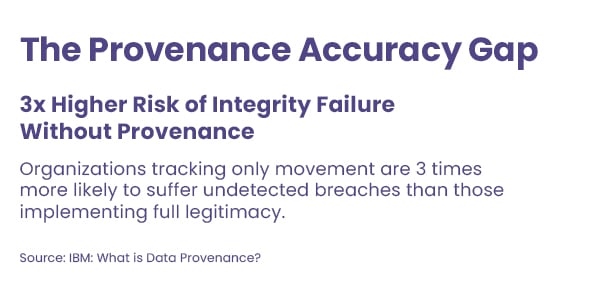
The scale of this problem is accelerating faster than many organizations realize. According to IBM’s research on data provenance versus data lineage, enterprises that rely solely on lineage – basic tracking of where data moves – are nearly three times more likely to experience undetected data integrity failures compared to those that implement full provenance, which captures intent, context, and transformation history.
This distinction matters profoundly in the age of synthetic fraud. While lineage tracks where a document went, provenance determines whether it should have existed in the first place.
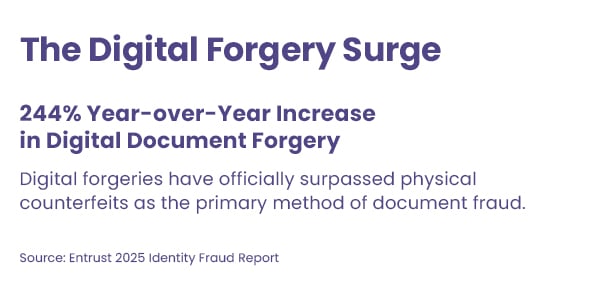
Synthetic fraud in 2026 is neither sloppy nor obvious. It is specifically engineered to defeat both human reviewers and legacy automation. Modern generative models can now:
Traditional OCR systems were designed to read text, not evaluate authenticity. Even advanced extraction engines may accurately capture every field from a fraudulent document, inadvertently accelerating its acceptance into downstream systems.
Manual review is equally vulnerable. While human reviewers excel at spotting inconsistencies when they know what to look for, synthetic documents are designed to look perfectly ordinary. At scale, fatigue and time pressure further increase the likelihood of oversight. Consequently, organizations are shifting toward forensic document intelligence, where the goal is not just extraction accuracy, but truth validation.
 How Does Intelligent Document Processing Enable AI Fraud Detection?
In 2026, Intelligent Document Processing (IDP) has evolved from automation technology into a critical security layer.
Advanced IDP platforms analyze documents across multiple dimensions simultaneously:
These systems can flag irregularities invisible to the human eye, such as subtle font substitutions, synthetic spacing patterns, or inconsistencies between declared values and historical norms.
However, detection alone is not enough. Once a document enters the system, organizations must be able to prove what happened next. That proof is delivered through digital provenance.
The difference between provenance and more familiar governance concepts is often misunderstood – and that misunderstanding is now a source of material risk. According to IBM’s data governance research, data lineage answers the question of movement, while data provenance answers the question of meaning and legitimacy. While lineage tracks where information flows, provenance records why it exists, how it was created, and whether it remains intact.
In environments shaped by AI-generated content, this distinction becomes critical. A fabricated document can have reliably traceable lineage inside a system while still being fundamentally fraudulent. Therefore, digital provenance is not simply enhanced logging; it is a semantic and cryptographic record of authenticity.
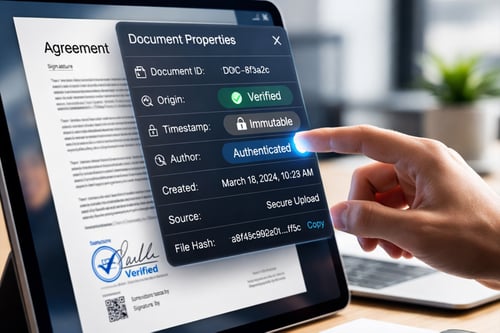
In modern document environments, provenance functions as a ledger for information – a continuously updated, cryptographically secured record that certifies a document’s lifecycle.
A robust provenance framework includes:
By anchoring these events to a blockchain-backed audit trail, organizations ensure that records cannot be retroactively altered or erased without detection. This is the foundation of Chain of Custody 2.0 – designed specifically for digital, distributed, and AI-driven operations.
In 2026, Intelligent Document Processing (IDP) has evolved from automation technology into a critical security layer. Blockchain’s role in document management is not about cryptocurrency or speculation. It is about immutability.
When document events are hashed and recorded to a distributed ledger:
For regulated industries, this provides something previously difficult to achieve: defensible automation. Auditors, regulators, and legal teams no longer need to rely solely on internal attestations. They can independently verify that a document has remained intact and unaltered since capture. In disputes, this level of proof can determine admissibility, liability, and outcome.
 As digital provenance matures, global standards are emerging to ensure interoperability and trust across platforms – and regulators are beginning to expect alignment. One of the most important developments is the C2PA (Coalition for Content Provenance and Authenticity) standard. C2PA defines a framework for embedding verifiable metadata that describes how digital content was created and modified.
In its 2026 strategic guidance on AI trust and risk, Gartner indicates that standards-based provenance frameworks are set to become a prerequisite for AI governance programs, particularly in regulated industries where explainability and auditability are mandatory.
While initially focused on media, C2PA principles are rapidly influencing enterprise document governance. By aligning provenance strategies with these standards, organizations future-proof their investments and ensure compatibility with evolving regulatory and ecosystem requirements.
Modern provenance capabilities are designed with this broader standards landscape in mind, ensuring that trust is portable and universally verifiable rather than locked into proprietary systems.
While the threat of synthetic fraud is universal, the implications vary significantly by sector. For organizations operating in highly regulated environments, digital provenance is moving from a technical preference to a core operational requirement, serving as the definitive barrier between automated efficiency and catastrophic risk.
 Financial Services
Banks and lenders face unprecedented exposure from AI-generated identity kits, fabricated income documentation, and falsified transaction records. By shifting from reactive detection to proactive verification, institutions can ensure that every digital asset in their ecosystem is legitimately sourced.
Digital provenance enables:
By anchoring trust at the point of capture, financial leaders transform security from an operational bottleneck into a distinct competitive advantage.

For state and local agencies, trust is foundational to legitimacy. As public interactions move toward full automation, maintaining an irrefutable record of government action is essential for transparency and public confidence.
Provenance-backed document systems provide:
These digital integrity layers allow agencies to scale services through automation while remaining fully accountable to the citizens they serve.

In legal proceedings and claims processing, the "chain of custody" determines the credibility of every decision. Organizations that rely on static PDFs are increasingly vulnerable to challenges regarding the authenticity of their evidence.
Immutable audit trails ensure:
In these high-stakes environments, move from a posture of defense to one of certainty by ensuring that every file carries its own verifiable proof of truth.
In each of these sectors, the transition to provenance-based security marks the end of the "trust but verify" era and the beginning of "verify to trust." By embedding mathematical certainty into the document lifecycle, high-risk industries can safely embrace the speed of AI while maintaining the absolute integrity required by law and public expectation.
Across every sector, the message is clear: without provenance, automation amplifies risk. With provenance, it multiplies value.
The convergence of AI and immutability is fundamentally reshaping how organizations detect and respond to deception. As generative tools become more sophisticated, the ability to correlate intelligence with unchangeable history has become the only viable path forward for digital trust.
Research from Splunk on deepfake detection and observability-driven security further demonstrates that organizations correlating provenance metadata with behavioral and system telemetry improve deepfake detection rates by more than 60% compared to relying on content analysis alone. This reinforces a critical insight: detecting synthetic fraud is not just about analyzing what a document looks like – it is about verifying its history.
The most powerful document environments in 2026 do not treat AI and security as separate layers; they converge them into a single, unified workflow. While AI-driven Intelligent Document Processing (IDP) provides the speed, scale, and intelligence needed to handle massive data volumes, blockchain-backed provenance provides the certainty, accountability, and trust required for high-stakes decision-making.
Together, these technologies enable:
By unifying these capabilities, organizations ensure that their automation is not just fast, but fundamentally trustworthy and resilient against manipulation.
This convergence is no longer theoretical; it is a baseline operational requirement that is reshaping how leading organizations define digital maturity and long-term security.
Scan-Optics is not just a technology provider. It is a strategic partner in building trusted information ecosystems. Through the easy.forward™ platform, Scan-Optics delivers an end-to-end Intelligent Data Management Cycle designed for 2026 and beyond:
The result is not just efficiency – it is confidence.
Transitioning from legacy storage to a verifiable digital future requires more than just new software; it requires a roadmap for immutable integrity. Explore how Scan-Optics is operationalizing the core pillars of digital provenance to define the next phase of secure document intelligence:
As authenticity becomes the ultimate safeguard for the modern enterprise, Scan-Optics integrates pioneering technology with deep expertise to navigate the complexities of data verification. We provide the forensic intelligence and immutable frameworks necessary to ensure your information remains defensible, accessible, and resilient against evolving threats. Partner with us to learn how Scan-Optics secures document provenance with easy.forward™ and helps your organization combat AI-driven fraud with confidence.

Discover the top digital scanning and document management trends shaping 2026, including AI-powered automation and intelligent workflows from...
Learn how to budget for digitizing documents in 2026. Explore cost drivers, vendor selection, ROI, and planning frameworks with Scan-Optics.
Discover how advanced data analytics and document scanning power smarter, faster decision-making in today’s digital-first world.
Your company data is your most valuable asset. Let us help you protect it.
